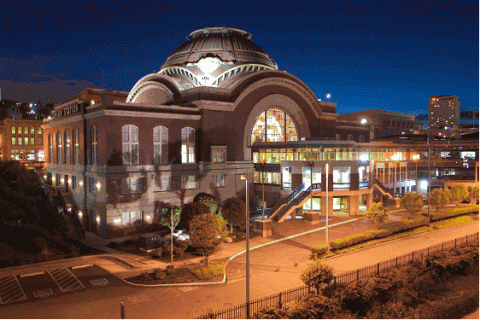
Judge Grady J. Leupold
Individual Rules, Standing Orders & Policies

Communication
Clerk
Document Filing Requirements9 rules
Peremptory challenges will be exercised simultaneously, with each party submitting a written list of the panelists it wishes to excuse.
If the Court denies a request to seal, counsel must advise the Court how the confidential material should be handled.
Court's wording
Counsel shall advise the Court of the requested disposi�on of confiden�al maters in the event the Court denies a request to seal (e.g., should the informa�on be removed from the docket rather than be unsealed).
Par�es moving to file documents under seal must comply with Local Rule CR 5(g). All mo�ons to seal, including s�pulated mo�ons, must describe with specificity the documents sought to be protected, provide facts jus�fying sealing, and include a proposed order.
- Document
- Motion to seal
Must include
- •Proposed order
All exhibits must be handled electronically; hard copies to Courtroom Deputy if needed
Court's wording
All exhibits will be handled electronically. If for some reason a hard copy exhibit becomes necessary, any such hard copy that counsel wishes to have the Court examine should be handed to the Courtroom Deputy.
When appearing in this Court, unless excused by Judge Leupold, all counsel (including any other people at counsel table), shall adhere to the following rules:
The DEPS program will be used for presenting exhibits. Any exhibit offered in evidence should, at the time it is offered, be displayed electronically first to opposing counsel.
In advance of each trial session, counsel for the party going forward at that session should show opposing counsel the exhibits s/he intends to introduce at the session. The opponent shall indicate those exhibits to which s/he has no objection, and the Court will admit them when offered at the session.
At the end of trial, counsel should make sure they have all of their exhibits. The Courtroom Deputy is not responsible for them.
If you intend to question a witness about a group of documents, avoid delay by having all the documents organized and electronically ready to use, when you start examination.
Filing & Service rules
Filing Timing and Cure Windows
If counsel cannot agree, a properly noted motion to seal must be filed before or at the same time as the document to be sealed.
If counsel cannot agree, then a properly noted mo�on to seal must be filed prior to or contemporaneously with the document to be sealed.
Civil cases
Page 1 | Motions to Seal — Requirements
Service and Proof of Service Rules
A party seeking to file a document another party claims is confidential must give the other parties at least 7 days’ notice, allowing the sealing proponent to prepare and file a motion to seal when the document is submitted.
If a party seeks to file a document that another party claims is confiden�al, the party seeking to file the document shall give at least 7 days’ no�ce to the other par�es so a mo�on to seal may be prepared and filed by the proponent of sealing at the same �me the document is submited.
Civil cases
Page 1 | Motions to Seal — Requirements
Sealing & Redaction Procedures
Evidence presented at trial, including confidential materials, is generally considered public record; parties may seek continued confidentiality, but the Court decides what becomes part of the public record.
The Court generally considers all evidence presented at trial, including confiden�al materials, to be maters of public record. Although the par�es may move or s�pulate to maintaining as confiden�al any sealed informa�on used at trial, the Court retains the authority to determine what evidence should be part of the public record.
Civil cases
Page 1 | Motions to Seal — Requirements
Pre-Motion Conference Requirements
Before filing a discovery motion, the moving party must make reasonable efforts to have all parties participate in contacting the Court to request a telephonic motion.
The moving party must make reasonable efforts to have all parties to the discovery dispute participate in contacting the Court to request a telephonic motion. See Local Civil Rule 7(i).
Civil cases
Page 1 | Discovery Issues
Chambers Communication Rules
Stand at lectern when examining witnesses, may approach for exhibits
Stand at the lectern while examining any witness—except that counsel may approach the Courtroom Deputy's desk or the witness for purposes of handling or tendering exhibits.
Page 1 | MAGISTRATE JUDGE GRADY J. LEUPOLD CONDUCT OF COUNSEL AT TRIAL
Request permission before approaching the bench
Request permission before approaching the bench.
Page 1 | MAGISTRATE JUDGE GRADY J. LEUPOLD CONDUCT OF COUNSEL AT TRIAL
Refer to all persons by surnames, not first names
Refer to all persons, including witnesses, other counsel, and parties by their surnames and not by their first or given names.
Page 1 | MAGISTRATE JUDGE GRADY J. LEUPOLD CONDUCT OF COUNSEL AT TRIAL
Stand when jury enters or exits courtroom in jury trials
In jury trials, stand when the jury enters or exits the courtroom.
Page 1 | MAGISTRATE JUDGE GRADY J. LEUPOLD CONDUCT OF COUNSEL AT TRIAL
Address all remarks to the Court, not opposing counsel
Address all remarks to the Court, not to opposing counsel.
Page 1 | MAGISTRATE JUDGE GRADY J. LEUPOLD CONDUCT OF COUNSEL AT TRIAL
Only one attorney per party may examine/cross-examine each witness
Only one attorney for each party shall examine, or cross-examine, each witness. The attorney stating objections, if any, during direct-examination, shall be the attorney recognized for cross-examination.
Page 1 | MAGISTRATE JUDGE GRADY J. LEUPOLD CONDUCT OF COUNSEL AT TRIAL
Stand when court is opened, recessed, or adjourned
Stand as Court is opened, recessed, or adjourned.
Page 1 | MAGISTRATE JUDGE GRADY J. LEUPOLD CONDUCT OF COUNSEL AT TRIAL
Be respectful of opposing counsel, litigants, and witnesses
Be respectful of opposing counsel and the litigants and/or witnesses.
Page 1 | MAGISTRATE JUDGE GRADY J. LEUPOLD CONDUCT OF COUNSEL AT TRIAL
Stand when addressing or being addressed by the Court
Stand when addressing, or being addressed by, the Court.
Page 1 | MAGISTRATE JUDGE GRADY J. LEUPOLD CONDUCT OF COUNSEL AT TRIAL
Do not face or address jurors when questioning witnesses
Do not face or otherwise appear to address yourself to jurors when questioning a witness.
Page 2 | MAGISTRATE JUDGE GRADY J. LEUPOLD CONDUCT OF COUNSEL AT TRIAL
Do not express personal knowledge or opinion in jury arguments
In opening statements and in argument to the jury, counsel shall not express personal knowledge or opinion in any matter in issue.
Page 2 | MAGISTRATE JUDGE GRADY J. LEUPOLD CONDUCT OF COUNSEL AT TRIAL
Sidebar conferences presumptively not tolerated except in extraordinary circumstances
Sidebar conferences will presumptively not be tolerated, except in extraordinary and unforeseen circumstances. These conferences have a distracting effect on the jury and the parties should strive to postpone raising issues outside the jury's presence until the next recess, except when an immediate conference appears necessary.
Page 2 | MAGISTRATE JUDGE GRADY J. LEUPOLD CONDUCT OF COUNSEL AT TRIAL
Those exhibits to which there is an objection shall be presented to the Court for ruling before the opening of the session. If possible, the Court will rule on the objection then, thereby eliminating the necessity for a sidebar conference when the exhibit is offered.
Those exhibits to which there is an objection shall be presented to the Court for ruling before the opening of the session. If possible, the Court will rule on the objection then, thereby eliminating the necessity for a sidebar conference when the exhibit is offered.
Page 2 | MAGISTRATE JUDGE GRADY J. LEUPOLD CONDUCT OF COUNSEL AT TRIAL
Offers of, or requests for, a stipulation should be made privately, not within the hearing of the jury.
Offers of, or requests for, a stipulation should be made privately, not within the hearing of the jury.
Page 2 | MAGISTRATE JUDGE GRADY J. LEUPOLD CONDUCT OF COUNSEL AT TRIAL
In making objections, counsel should state only the legal grounds for the objection and should withhold all further comment or argument unless elaboration is requested by the Court.
In making objections, counsel should state only the legal grounds for the objection and should withhold all further comment or argument unless elaboration is requested by the Court.
Page 2 | MAGISTRATE JUDGE GRADY J. LEUPOLD CONDUCT OF COUNSEL AT TRIAL
Counsel may email Deputy Clerk Kelly Miller to arrange a telephone conference with the Court.
Counsel may contact the Court’s deputy clerk Kelly Miller by email at kelly_miller@wawd.uscourts.gov or by telephone at 253-882-3828 to arrange a telephone conference with the Court.
Civil cases
Page 1 | Discovery Issues
Junior Lawyer Participation Incentives
Court encourages Rule 9 interns and junior attorneys to argue, permits multiple attorneys to argue for one party.
The Court encourages opportunities for Rule 9 licensed legal interns, accompanied and supervised by a more experienced attorney, and for junior attorneys to appear and to argue in Court. Requests for leave for Rule 9 interns to argue in Court will be freely granted, and the Court will permit multiple attorneys to argue for one party if this creates an opportunity for junior attorneys to participate.
Page 1 | Attorney Development
Junior lawyers with less than 7 years experience are encouraged to conduct hearings, especially when they contributed to the motion papers.
The Court encourages parties and counsel to be mindful of opportunities for new lawyers (practicing less than seven years) to conduct hearings before the Court, especially where these lawyers drafted or significantly contributed to motions and responses.
Page 1 | Courtroom Rules