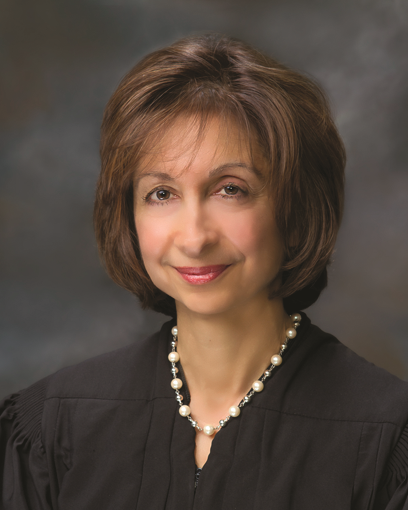
Judge Sheila K. Oberto
Individual Rules, Standing Orders & Policies
- Rules last changed:

Limits & Logistics
Document Limits
Courtesy Copies
Courtesy copies
Filings > 25 pages
Binding: Stapled

Communication
Chambers
Clerk
Phone
Clerk
Page & Word Limits2 rules
Moving/opposition briefs limited to 25 pages; reply briefs limited to 10 pages.
- Brief
- Up to 25 pages
- Reply brief
- Up to 10 pages
Exception
More pages with leave of court
Court's wording
Unless prior leave of Court is obtained seven days before the filing date, all moving and opposition briefs or legal memorandum in civil cases shall not exceed 25 pages. Reply briefs filed by moving parties shall not exceed 10 pages.
Unless prior leave of Court is obtained seven days before the filing date, all moving and opposition briefs or legal memorandum in civil cases shall not exceed 25 pages. Reply briefs filed by moving parties shall not exceed 10 pages.
- Brief
- Up to 25 pages
- Reply brief
- Up to 10 pages
Exception
More pages with leave of court
Document Format Requirements1 rule
As required by Local Rule 137(b), counsel shall submit all proposed orders, stipulations, etc., in Microsoft Word format, to chambers at skoorders@caed.uscourts.gov.
- File type
- Word
- Proposed order
- Stipulation
Formatting
- •Submit to skoorders@caed.uscourts.gov via email
Document Filing Requirements13 rules
Any brief exceeding 15 pages shall include a table of contents and a table of authorities.
- Document
- Brief
Must include
- •Table of contents
- •Table of authorities
Pursuant to Local Rule 131(c), the documents should include the attorneys’ electronic signatures (i.e. /s/First/Last Name), as well as the date the document was signed.
Professionalism and civility are mandatory in this courtroom.
Gum chewing, non-court reading, and noise-making electronics prohibited during court sessions.
Court's wording
Gum chewing and non-court related reading (such as newspapers or magazines) are prohibited while court is in session. Beepers, cellular telephones and other noise-making electronic equipment must also be placed on silent or turned off while Court is in session.
Offers of, or requests for, a stipulation should be made privately, outside of the presence of the jury.
Objections must be brief and limited to stating the objection and basis; no speaking objections allowed.
Court's wording
Objections are to be limited to stating "objection" and the basis for the objection ("Objection, leading") or the number of the Federal Rule of Evidence relied upon (e.g., "Objection, Rule 403"). Do not explain or argue the grounds for objections in the presence of the jury unless asked to do so by the Judge. "Speaking Objections" are not allowed and will be overruled.
Counsel shall not make motions (e.g., a motion for a mistrial) in the presence of the jury. Such matters may be raised at recess.
Please address all remarks to the Judge, not opposing counsel, and refrain from making disparaging or acrimonious remarks toward opposing counsel or witnesses.
In opening statements and closing arguments to the jury, counsel shall not express counsel's own personal knowledge or personal opinion concerning any matter in dispute.
Counsel must not refer to excluded evidence or testimony in jury's presence.
Court's wording
Counsel shall not, in the jury's presence, refer to any matter, witness, exhibit, or testimony that has been excluded by an order granting a motion in limine, or to which an objection was sustained, and/or motion to strike has been granted.
Prior to the close of each business day, counsel shall provide opposing counsel with a list of witnesses counsel intends to call the next day.
Anticipate trial problems and address them outside jury presence; motions in limine encouraged; bench conferences require permission.
Court's wording
Counsel should try to anticipate problems that will arise during trial and take them up with the Court and opposing counsel out of the presence of the jury. Appropriate motions in limine in advance of trial are encouraged. If during trial it becomes necessary for an attorney to confer with the Court at the bench, the Court's permission should be obtained.
Opening/closing statements may be divided among multiple counsel with court permission.
Court's wording
Upon obtaining prior permission of the court, motions, the opening statement, or closing argument may be divided among counsel if a party has more than one trial counsel, if different subjects are addressed by counsel.
Filing & Service rules
Courtesy Copy Requirements
Courtesy Copies of ALL Motion-Related Pleadings over 25 pages should be properly tabbed, fastened, and clearly identified as a "Courtesy Copy" (to avoid duplicate and erroneous filing by court staff) and shall be mailed in hard copy to the Court, Attn: Judge Oberto.
Courtesy Copies of ALL Motion-Related Pleadings over 25 pages should be properly tabbed, fastened, and clearly identified as a "Courtesy Copy" (to avoid duplicate and erroneous filing by court staff) and shall be mailed in hard copy to the Court, Attn: Judge Oberto.
Page 1 | Civil Law and Motion Calendar
Courtesy Copies of ALL Motion-Related Pleadings over 25 pages should be properly tabbed, fastened, and clearly identified as a "Courtesy Copy" (to avoid duplicate and erroneous filing by court staff) and shall be mailed in hard copy to the Court, Attn: Judge Oberto.
Courtesy Copies of ALL Motion-Related Pleadings over 25 pages should be properly tabbed, fastened, and clearly identified as a "Courtesy Copy" (to avoid duplicate and erroneous filing by court staff) and shall be mailed in hard copy to the Court, Attn: Judge Oberto.
Civil cases
Page 1 | Civil Law and Motion Calendar:
Chambers Communication Rules
Chambers email address is skoorders@caed.uscourts.gov for submitting proposed orders and stipulations.
e-mail: skoorders@caed.uscourts.gov
Civil cases
Page 1 | Header
Courtroom Deputy Clerk Yee Vue can be contacted via email yvue@caed.uscourts.gov or phone (559) 499-5790.
Courtroom Deputy Clerk, Yee Vue yvue@caed.uscourts.gov Office: (559) 499-5790
Civil cases
Page 1 | Header