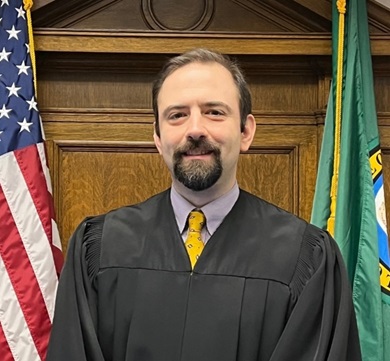
Judge Taki Flevaris
Individual Rules, Standing Orders & Policies

Limits & Logistics
Courtesy Copies
Deposition Designations
Court-wide- As Directed in Pretrial Order
Filings >= 500 pages
Court-wide- Hand Delivery

Adjournments
- Continuance motions filed after the Case Schedule deadline will be granted only upon extraordinary circumstances with no alternative means of preventing a substantial injustice.
- Even when a motion for a continuance is agreed, the parties should make a basic showing that satisfies the applicable standard.
- Trial continuances require a good-cause showing of diligence and need, including what preparation is complete, what remains, and why the case could not be completed on the original schedule.
Request must include
Document Format Requirements1 rule
Whenever possible, the proposed order should be submitted in editable Word (.doc) format, with the proponent's signature included in electronic format—whether a digitally certified signature, "s/" signature, or electronic image of the person's signature. See General Rule 30; RCW 1.80.010(10). For joint motions, signatures from each and every proponent should be included.
- File type
- Word
- Proposed order
Formatting
- •Editable Word (.doc) format whenever possible
Document Filing Requirements22 rules
Consistent with the above standard, and given that revision must be based only on the issues and evidence before the Commissioner, the motion should only: (1) provide the hearing information required by LCR 7(b)(8)(B)(iii); (2) identify the error(s) claimed; (3) specify where exactly in the record the issue was argued below; and (4) specify all evidence in the record relevant to the issue (whether in support or opposition). The Court will then determine whether or not to call for supplemental briefing or argument.
Written submissions must support disputed material assertions with particularized citations (specific page/section/paragraph), docket citations with specific docket number and page, and legal authority with pincites and parentheticals where needed.
Court's wording
The use of clear, specific citations is of utmost importance in written submissions to the Court. Parties cannot and should not rely on the Court to pore over the record to confirm their assertions. Instead, any disputed, material assertions should be supported with a particularized citation to supporting materials. This should include a specific page number, section, or paragraph for each citation. References to prior filings should be supported with particularized citation to the docket (referenced as "Dkt.," "Sub No.," or equivalent) that indicates the specific docket number and specific page (e.g., "Dkt. 1 at 22"). Any disputed or distinctive legal propositions should be supported with citation to legal authority, including a pincite (page number), and when not already apparent, a parenthetical briefly describing the holding or significance of the cited authority. Legal citations need not include parallel citation to regional reporters or the like; citation to the Washington reporter or the U.S. reporter is sufficient and preferred.
The motion should NOT present further argument or factual assertions, which generally will be disregarded. The opposing party need not submit a motion to strike such extraneous information and is urged not to do so; such a motion itself will likely be struck as moot.
All parties moving for revision of a Commissioner's order will be held to the requirement under Local Rule 7(b)(8)(A) that the motion "shall only identify the error(s) claimed."
Factual declarations submitted in support of motions or other briefing should meet the requirements of General Rule 13 (certification), Local Civil Rule 7(b)(5)(B) (form), and Evidence Rule 701 (lay opinion).
Any request for attorney fees must specify the legal grounds for the requested award, and usually should be accompanied by a fee declaration explaining counsel's relevant experience and rates, with a log of time entries indicating tasks performed and time spent on each. The fee declaration should also indicate whether or not the time entries were created contemporaneously, and whether or not the entries have actually been or will be paid.
Discovery motions require a certification that the CR 26(i) meet-and-confer conference occurred, detailing its time, nature, and extent; the conference must be contemporaneous communication and email alone does not suffice.
Must include
- •Certificate of conference
Court's wording
Parties must pay careful attention to the "meet and confer" requirement of Civil Rule 26(i). The conference must consist of contemporaneous communication, whether in-person, virtual, or by telephone. Email is not a substitute for a dialogue on disputed issues. A certification by counsel that the conference requirement has been met is required, and should set out with particularity the time, nature, and extent of the conference.
Each error in a motion for revision must include a 1-3 sentence issue statement and specify record locations for argument and evidence.
Court's wording
For each error, include a short issue statement of 1-3 sentences, specify exactly where in the record the issue was argued to the Commissioner, and exactly where all relevant evidence before the Commissioner may be found, by docket number and page range.
To promote clarity and compliance with attestation requirements, factual declarations should NOT be combined with legal argument. Instead, whatever a witness is attesting to must be set forth separately and distinctly. Legal argument should then cite (with particularity) to the attested facts in support.
Counsel for any party seeking post-sentencing relief should file a Notice of Appearance and any motion papers and submit proposed orders via Working Copies. Whenever possible, the proposed order should be submitted in editable Word (.doc) format, with the proponent's signature included in electronic format—whether a digitally certified signature, "s/" signature, or electronic image of the person's signature. See General Rule 30; RCW 1.80.010(10). For joint motions or stipulated orders, signatures from each and every proponent should be included.
- Document
- Post-sentencing relief motion
Should include
- •Proposed order
To maintain a clear and appropriate record, the motion itself should be filed separately into the docket, and the Parties' proposed order should be presented separately to this Department for review. The proposed orders should comply with the standards set forth above for such submissions.
- Document
- Stipulated motion
Should include
- •Proposed order
Written submissions should refer to parties and other persons by individualized names or unique identifiers rather than only generic roles.
Court's wording
To promote clarity and ease of comprehension in briefing, declarations, and other written submissions, Parties and other persons should be regularly referred to by individualized name or other unique identifier rather than only generic role (e.g., "Plaintiff Smith" rather than just "Plaintiff"). Reference by first name may be necessary where the Parties share last name; this will not be taken as a sign of disrespect and no disclaimer to that effect is needed. Any person's disclosed or otherwise known personal pronouns should be respected.
Citations to the record should specify the specific docket number and page range for each portion of relevant argument or evidence (e.g., "Dkt. 12 at 15-17"), and nothing more.
For the purpose of identifying the error(s) claimed, which is subject to de novo review, the moving party should present a single, separate concise statement for each error akin to an assignment of error on appeal. Each statement should be no more than a few sentences long.
Any special relief from the Court—whether in discovery or otherwise—should be sought timely via written motion with supporting materials.
Parties should submit proposed orders via Working Copies that make clear precisely what the Party is asking the Court to do.
Significant trial determinations should be raised through a single motion in limine submission noted for the Trial Date and handled per Local Civil Rule 7.
Court's wording
If the Parties are aware of any significant legal determinations that will need to be made at Trial (rather than leading up to the Pretrial Conference), they should raise those issues through Motions in Limine. This should take the form of a single written submission noted for consideration on the Trial Date and timely prepared, filed, served, and answered in accordance with the requirements of Local Civil Rule 7. Issues raised in this manner usually will be addressed and resolved at the outset of Trial.
The parties are also urged to include proposed word counts.
If an opposing party believes the moving party's citations to the record are materially incomplete, they may file and serve a supplemental Revision Sheet with additional citations and nothing more.
Participants are encouraged to indicate their personal pronouns to the Bailiff, within written submissions, and in their Zoom names.
Court's wording
Consistent with General Rule 43, any and all participants in court proceedings before Department 38 are encouraged to inform the Bailiff of their personal pronouns, to indicate the same within any written submissions, and for virtual proceedings to indicate the same within their Zoom name (as Judge Flevaris does).
The moving party is urged to use this Department's Revision Form for the purpose of meeting the above standards. Otherwise, the Court may ask the moving party to fill out the Sheet as a supplement to their motion.
Any Party may request an exception from the above standards based on a showing of need particular to the case.
Filing & Service rules
Filing Timing and Cure Windows
All memoranda, reports, or other documents submitted for consideration at sentencing must be on file prior to the sentencing hearing.
Parties are to ensure that any memorandum, report, or other document submitted for the Court's consideration at sentencing is on file prior to the hearing.
Page 1 | Criminal Sentencing and Post-Sentencing Relief
Motions to shorten time are strongly disfavored; the underlying motion must be noted in the regular course with a separate motion to shorten time, and briefing proceeds on the default timeline unless shortened time is granted.
Motions to shorten time are strongly disfavored, and should only be used in extraordinary circumstances. If a party wishes the Court to consider a motion on shortened time, the underlying motion must be noted in the regular course, and a separate motion to shorten time should be submitted. Unless and until the Court grants the motion to shorten time, all responses and replies should be submitted as though the motion is to be considered on the presumptive, default timeline.
Page 1 | Motions for Expedited Review
Stipulated motions may be noted for consideration two judicial days after filing.
Stipulated motions may be noted for consideration two judicial days after filing. See LCR 7(b)(4)(H).
Page 1 | Stipulated Motions and Orders
Sealing & Redaction Procedures
Motions to seal must comply with GR 15, LGR 15, and controlling caselaw; party agreement is insufficient, and a proposed order with the required findings must be provided.
Motions to seal must comply with General Rule 15, Local General Rule 15, and controlling caselaw. Agreement of the parties is not a sufficient basis for sealing of court records. The moving party should provide a proposed order that includes the required findings.
Page 1 | Sealing Court Filings
GR 22 cover sheets may only be used to seal filings meeting the cover sheet standards (without altering the form); otherwise a motion to seal under GR 15/LGR 15 is required.
The use of form cover sheets to seal filings as authorized under General Rule 22 should be used only to seal filings that satisfy the particular standards set forth in the relevant cover sheet and General Rule 22, and the contents of the cover sheet should not be altered when filling out the form. Otherwise, a party must move to seal any given record pursuant to General Rule 15 and Local General Rule 15.
Page 1 | Sealing Court Filings
Filing Bundling Requirements
For cross-motions for summary judgment, parties are strongly urged to stipulate to four briefs filed sequentially (with combined opposition/cross-motion and reply/cross-opposition) rather than six briefs in two parallel sets.
If there will be cross-motions, the parties are strongly urged to agree upon and submit for approval a stipulated briefing schedule of four briefs filed sequentially (opening motion, combined opposition/cross-motion, combined reply/cross-opposition, and cross-reply) rather than six briefs filed in two parallel sets.
Page 1 | Motions for Summary Judgment
Pre-Motion Conference Requirements
Parties must coordinate and confirm a hearing date and time with the Bailiff before filing a Notice of Hearing for any summary judgment motion.
For any motions for summary judgment, in full or in part, the parties must coordinate and then confirm a hearing date and time with the Bailiff before filing a Notice of Hearing. If multiple parties intend to file such a motion, the parties should strive to streamline their presentations as much as practicable.
Page 1 | Motions for Summary Judgment
Parties are encouraged to request a CR 16/CR 26(f) pretrial conference to address discovery scope, limits, e-discovery protocols, and expert disclosures.
Judge Flevaris encourages the parties to request a pretrial conference under CR 16 or CR 26(f) to consider matters such as: (1) the scope and timing of discovery; (2) limitations of discovery requests and depositions; (3) procedures and protocols for electronic discovery; (4) expert witness disclosures and discovery; and (5) anything else that would promote the efficient resolution of the case.
Page 1 | Civil Discovery
Before formal discovery motions, parties are urged to request a short (10-20 minute) virtual or telephonic conference by emailing the Bailiff with brief, neutral issue descriptions and confirmation that meet-and-confer has occurred.
If a discovery dispute remains after conferencing, the Parties are urged to consider whether a short virtual or telephonic conference with the Court could help resolve or at least narrow the remaining issues without need for a formal motion. Any Party may email this Department's Bailiff, copying all counsel and unrepresented parties, to arrange such a conference. The email should describe the nature of the discovery dispute briefly (1-2 sentences per issue), in neutral terms, and without argument; and must confirm that the meet-and-confer requirement has already been met. The opposing party may then identify, also briefly and in neutral terms, any additional issues to be addressed. Such a conference usually will be scheduled for 10 to 20 minutes.
Page 1 | Civil Discovery
Adjournment & Extension Requirements
Continuance motions filed after the Case Schedule deadline will be granted only upon extraordinary circumstances with no alternative means of preventing a substantial injustice.
Parties should also heed the deadline to move for a trial continuance as set forth in the Case Schedule. Local Civil Rule 40(e)(2) provides that motions filed after that deadline "will not be granted except under extraordinary circumstances where there is no alternative means of preventing a substantial injustice." The motion should demonstrate this standard is met, otherwise it will likely be denied.
Page 1 | Motions for a Trial Continuance
Trial continuances require a good-cause showing of diligence and need, including what preparation is complete, what remains, and why the case could not be completed on the original schedule.
A continuance of the trial date generally requires showing good cause, including both diligence and need. The motion should be accompanied by a showing of what discovery and trial preparation have already been completed, what remains to be accomplished, and why the case could not have been completed within the original schedule. The mere assertion that more time is needed for discovery or negotiation, without more, will not usually constitute good cause.
Page 1 | Motions for a Trial Continuance
Even when a motion for a continuance is agreed, the parties should make a basic showing that satisfies the applicable standard.
Even when a motion for a continuance is agreed, the parties should make a basic showing that satisfies the applicable standard.
Page 1 | Motions for a Trial Continuance
Chambers Communication Rules
All case communications with the Bailiff must use only the courtroom email address, copy all other parties, and not use the Judge's individual address absent express invitation.
Parties must comply with the Court's email policy when contacting the Court. Per the policy, the only address to be used by attorneys, unrepresented litigants, or others who need to communicate with the Bailiff about a case is the courtroom email address. All other parties to the case must be copied on such communications. The Judge's individual address is not to be used absent express invitation.
Page 1 | Communicating with the Court
Phone should not be used unless there is no other available means of communication, and in that instance, the case number should be clearly identified at the outset of any call or voicemail.
Phone should not be used unless there is no other available means of communication, and in that instance, the case number should be clearly identified at the outset of any call or voicemail.
Page 1 | Communicating with the Court
If no agreement on cross-motion streamlining is reached, any party may (and is urged to) email the Bailiff to request a short conference for direction on streamlining.
If agreement cannot be reached, any party may and is urged to email the Bailiff to request a short conference with the Court to obtain direction on appropriate streamlining.
Page 1 | Motions for Summary Judgment