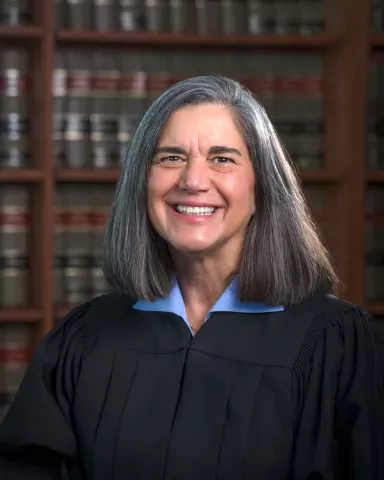
Judge Susan van Keulen
Individual Rules, Standing Orders & Policies
- Rules last changed:

Limits & Logistics
Document Limits
Courtesy Copies
Courtesy copies
- 2 copies
- Upon request
Hearing Materials
- 2 copies • At Hearing
Joint Pretrial Statement
- 2 copies • Within 24 Hours

Adjournments
- A settlement conference continuance requires a compelling reason, a prior meet-and-confer, and a prompt ECF request stating the reason and whether any party objects.
Request must include
- Administrative motion required 5 days before hearing to appear by Zoom/phone instead of in-person

Communication
Clerk, Chambers
Page & Word Limits5 rules
Each party's responses to motions in limine must be contained in a single document that does not exceed 15 pages double-spaced in 12-point font.
- Response to motion in limine
- Up to 15 pages per party
For all other motions in limine, each side may file not more than 5 motions in limine set forth in a single document that does not exceed 15 pages double-spaced in 12-point font.
- Motion in limine
- Up to 15 pages
Unless otherwise permitted by the Court, only one Motion for Summary Judgment, Partial Summary Judgment, or Summary Adjudication may be filed by each party.
The joint statement must not exceed 10 pages, exclusive of the caption page, double-spaced with 12-point font and in text-searchable PDF format.
- Joint statement
- Up to 10 pages
- Format
- Double-spaced; 12-point
Excluded from page count
- •Caption
Motions in limine must be filed 14 days before pretrial conference; responses due 7 days before; combined documents limited to 20 pages each.
- Motion in limine
- Up to 20 pages in total per party
- Response to motion in limine
- Up to 20 pages in total per party
Exception
More pages with leave of court
Court's wording
All other motions in limine must be filed at least 14 days before the pretrial conference, with responses due 7 days before the pretrial conference. No party may file a reply without leave of Court. Except as otherwise ordered by the Court, each party’s motions in limine must be combined in a single document not to exceed 20 pages, and each party’s responses to motions in limine must be combined in a single document not to exceed 20 pages.
Document Format Requirements10 rules
No later than seven days prior to the conference, the parties must send the following statements in text-searchable PDF format to svkcrd@cand.uscourts.gov.
- File type
- Settlement conference statement
Exhibit cover pages must include exhibit number and title/description.
- Exhibits
Formatting
- •Exhibit cover page must include exhibit number
Court's wording
The cover page of any exhibit submitted in connection with briefing on a motion must include the exhibit number and the title or brief description of the exhibit (e.g., “Ex. 1 – 1/1/2023 email from Joe Smith to Nancy Jones”).
The joint statement must not exceed 10 pages, exclusive of the caption page, double-spaced with 12-point font and in text-searchable PDF format.
- File type
- Font size
- 12 points
- Line spacing
- Double
- Joint statement
All stipulations and proposed orders are to be emailed in Word format to svkcrd@cand.uscourts.gov on the same day as the documents are e-filed.
- File type
- Word
- Stipulation
- Proposed order
Each party's responses to motions in limine must be contained in a single document that does not exceed 15 pages double-spaced in 12-point font.
- Font size
- 12 points
- Line spacing
- Double
For all other motions in limine, each side may file not more than 5 motions in limine set forth in a single document that does not exceed 15 pages double-spaced in 12-point font.
- Font size
- 12 points
- Line spacing
- Double
- Motion in limine
Exhibit list must be in landscape orientation, numerically ordered, with specific columns.
- Exhibit list
Formatting
- •Landscape orientation
- •Organized numerically
- •Columns: exhibit number, description, sponsoring witness
Court's wording
The chart must be in landscape orientation, must be organized in numerical order by exhibit number, and must include columns containing the following information for each exhibit: 1. An exhibit number. 2. A brief description of each exhibit's contents and purpose. 3. The identity of each sponsoring witness.
All items must be in text-searchable PDF format.
- File type
Formatting
- •Text-searchable
Footnotes limited to clarification/cross-references; argument in footnotes not considered; must comply with Local Rule 3-4(c)(2); excessive/ improper footnotes may be stricken.
- Font size
- 12 points
- Line spacing
- Double
Formatting
- •Footnotes limited to clarification/cross-references
- •Argument in footnotes not considered
Court's wording
Use of footnotes in Court filings is to be limited to providing brief points of clarification or cross-references. Argument in footnotes will not be considered by the Court. The form of footnotes must comply with Civil Local Rule 3-4(c)(2). The Court may strike any filing that includes excessive or improper footnotes.
Use of footnotes in Court filings is to be limited to providing brief points of clarification or cross-references. Argument in footnotes will not be considered by the Court.
Document Filing Requirements20 rules
The joint settlement conference statement must identify attendees and address the case facts, claims and defenses, proceedings and schedule, pending motions, and relief sought.
Court's wording
1. A joint settlement conference statement. The joint settlement conference statement must include: - (a) the identity of the attorney(s) and clients attending the settlement conference; - (b) a brief statement of the facts of the case; - (c) a brief statement of the claims and defenses raised, including statutory or other grounds upon which the claims are founded; - (d) a bullet-point summary of the proceedings to date, including the operative case schedule; - (e) a list of all pending motions; - (f) the relief sought; and
The confidential addendum must not be served on other parties and must candidly assess likelihood of success, identify major and potentially case-resolving issues, and state the party's settlement value.
Court's wording
2. A confidential addendum to the joint statement. The confidential addendum is not to be served on any other party and must include: (a) a *candid* evaluation of the parties' likelihood of prevailing on the claims and defenses; (b) a brief description of the major issues in dispute and any discrete issue that, if resolved, would facilitate the resolution of the case; (c) the party's settlement value of the case.
(g) the parties' positions on settlement exchanged as of the date of the joint statement, including a history of settlement discussions and the present demands and offers.
When submitting a proposed order pursuant to Civil Local Rule 79-5(c)(3), the table format included in the order shall comply with the below format: | Document | Text to be Sealed | Basis for Sealing | | --- | --- | --- | | | [redacted portions to be identified by page and line number]
Joint case management statement must include case schedule first and all required information per standing order.
Court's wording
Joint case management statements must include as the first item the case schedule, if it has been set, as well as all information required under the Standing Order for All Judges of the Northern District of California — Contents of Joint Case Management Statement.
No party may file a reply without leave of Court.
All stipulations and proposed orders are to be emailed in Word format to svkcrd@cand.uscourts.gov on the same day as the documents are e-filed.
- Document
- Stipulation
Include
- •Proposed order
Motions to seal must follow specific table format for proposed orders under Civil Local Rule 79-5
- Document
- Motion to seal
Must include
- •Proposed order
Court's wording
Motions to seal shall be filed in accordance with Civil Local Rule 79-5. When submitting a proposed order pursuant to Civil Local Rule 79-5(c)(3), the table format included in the order shall comply with the below format: Document Text to be Sealed Basis for Sealing [redacted portions to be identified by page and line number]
Designating Party must attach proposed public redacted version of documents when responding to motion to seal under Civil Local Rule 79-5(f)
Court's wording
Where a party (“Filing Party”) files a motion to consider whether another party’s (“Designating Party”) materials should be sealed pursuant to Civil Local Rule 79-5(f), the Designating Party’s statement and/or declaration in support of sealing pursuant to Civil Local Rule 79-5(f)(3) shall attach as exhibit(s) the proposed, public, redacted version of the document(s) sought to be sealed to the extent the proposed redactions differ from the redactions proposed by the Filing Party.
Exhibit cover pages must include exhibit number and title/description.
- Document
- Exhibits
- Placement
- First page
Court's wording
The cover page of any exhibit submitted in connection with briefing on a motion must include the exhibit number and the title or brief description of the exhibit (e.g., "Ex. 1 – 1/1/2023 email from Joe Smith to Nancy Jones").
The joint statement must also include each party's proposed order as an exhibit.
- Document
- Joint statement
Must include
- •Proposed order
Word versions of the joint chart exhibit and each party’s proposed order must also be emailed to svkcrd@cand.uscourts.gov
Word versions of the joint chart exhibit and each party's proposed order must also be emailed to svkcrd@cand.uscourts.gov
Signature on AI-generated submissions certifies personal verification of accuracy.
Court's wording
The signature of counsel or a self-represented party on any submission containing AI- generated content, including citations generated by AI, constitutes a certification that the signing attorney (or self-represented party) has personally verified the content’s accuracy.
Counsel is responsible for providing complete and accurate representations in any submission (including filings, demonstratives, evidence and oral argument) to the Court as required by Rule 11 of the Federal Rules of Civil Procedure, the California Rules of Professional Conduct, and any other applicable legal or ethical guidance. Use of generative AI tools, such as ChatGPT, Claude, Gemini, etc., in preparing submissions to the Court is not prohibited, but counsel and self-represented parties must at all times personally confirm for themselves the accuracy of any content generated by these tools. The signature of counsel or a self-represented party on any submission containing AI- generated content, including citations generated by AI, constitutes a certification that the signing attorney (or self-represented party) has personally verified the content’s accuracy. The Court will impute any errors by such AI tools to the attorney or party whose signature appears on the document containing those errors. Failure to verify the accuracy of submissions, particularly the accuracy of citations to law and evidence, may be grounds for sanctions. Counsel is responsible for maintaining records of all prompts or inquiries submitted to any generative AI tools in the event those records become relevant at any point.
- Document
- All submissions
Must include
- •AI disclosure
Amended pleadings must include redline exhibit showing changes; pro se parties exempt.
Court's wording
If a party filed an amended complaint or other amended pleading, they must also file as an exhibit to the pleading a redline version showing what changes have been made to the most-recent version. Self-represented parties are not required to comply with this requirement.
Joint case management statements must include as the first item the case schedule, if it has been set, as well as all information required under the Standing Order for All Judges of the Northern District of California – Contents of Joint Case Management Statement.
If a party files a dispositive motion (such as a motion to dismiss or a motion for remand), the moving party must file the consent or declination simultaneously with the motion.
Electronic equipment must be requested 5 days before trial and tested in courtroom.
Must include
- •Proposed order
- •Request and proposed order
Court's wording
If a party wishes to use electronic equipment or other large items (such as bookshelves), the party must file a request and proposed order with the Court no later than 5 days prior to trial. Equipment not provided by the Court must be tested in the courtroom prior to the day when it will be used. Arrangements for such testing may be made with the Courtroom Deputy.
Joint Pretrial Statement must include Proposed Order, jury/bench notification, witness list, expert witness list, and exhibit list with specific formatting.
Court's wording
At least 21 days before the Pretrial Conference, the parties must file in ECF a Joint Pretrial Statement that includes as attachments the items listed below. All items must be in text-searchable PDF format. A. Proposed Order Re: Trial Stipulations ... B. Jury or Bench Trial ... C. Witness List ... D. Expert Witness List ... E. Exhibit List ...
Filing & Service rules
Electronic Filing Rules
The required statements must be sent to the Court by email and must not be filed in ECF.
No later than seven days prior to the conference, the parties must send the following statements in text-searchable PDF format to svkcrd@cand.uscourts.gov. The statements must not be filed in ECF.
Civil cases
Page 1 | SETTLEMENT CONFERENCE STATEMENT
Joint Pretrial Statement must be filed in ECF.
At least 21 days before the Pretrial Conference, the parties must file in ECF a Joint Pretrial Statement that includes as attachments the items listed below.
Civil cases
Page 2 | IV. JOINT PRETRIAL STATEMENT
Filing Timing and Cure Windows
The parties must email the required statements as text-searchable PDFs no later than seven days before the conference and must not file them in ECF.
No later than seven days prior to the conference, the parties must send the following statements in text-searchable PDF format to svkcrd@cand.uscourts.gov. The statements must not be filed in ECF.
Civil cases
Page 1 | SETTLEMENT CONFERENCE STATEMENT
A party objecting to a continuance must file an ECF opposition within two days after the request is filed.
Any party that objects to the continuance must file an opposition in ECF within two days of the filing date of the request for the continuance.
Civil cases
Page 1 | SCHEDULING
File administrative motion to appear by Zoom at least 5 days before hearing.
Any deviation from the appearance standards above requires prior approval of the Court. The requesting party must file an administrative motion to appear by Zoom video link or telephonic link at least 5 days before the hearing.
Civil cases
Page 1 | LOCATION
Joint case management statement due one week before case management conference.
all joint case management statements are due one week before the case management conference.
Civil cases
Page 2 | CASE MANAGEMENT CONFERENCE STATEMENTS
File consent or declination simultaneously with any dispositive motion.
If a party files a dispositive motion (such as a motion to dismiss or a motion for remand), the moving party must file the consent or declination simultaneously with the motion.
Civil cases
Page 2 | CASES INITIALLY ASSIGNED TO JUDGE VAN KEULEN: CONSENT OR DECLINATION
File consent or declination by deadlines in Civil Local Rule 73-1(a).
each party must file written consent to the jurisdiction of a magistrate judge or a written request for reassignment to a district judge as soon as possible but no later than the deadlines specified in Civil Local Rule 73-1(a).
Civil cases
Page 2 | CASES INITIALLY ASSIGNED TO JUDGE VAN KEULEN: CONSENT OR DECLINATION
Responses to motions in limine due 14 days before the Pretrial Conference.
Responses to motions in limine are due 14 days before the Pretrial Conference.
Civil cases
Page 1 | III. MOTIONS IN LIMINE
Joint Pretrial Statement must be filed at least 21 days before the Pretrial Conference.
At least 21 days before the Pretrial Conference, the parties must file in ECF a Joint Pretrial Statement that includes as attachments the items listed below.
Civil cases
Page 2 | IV. JOINT PRETRIAL STATEMENT
Motions in limine must be filed at least 27 days before the Pretrial Conference.
Motions in limine must be filed at least 27 days before the Pretrial Conference.
Civil cases
Page 1 | III. MOTIONS IN LIMINE
Service and Proof of Service Rules
The confidential addendum must not be served on any other party.
The confidential addendum is not to be served on any other party
Civil cases
Page 2 | SETTLEMENT CONFERENCE STATEMENT
Courtesy Copy Requirements
Parties distributing hearing materials must provide two color copies to Court and one copy to other parties.
Any party who distributes materials at the hearing on any matter must supply the Court with two color copies of those materials at the hearing and all other parties with at least one copy.
Civil cases
Page 3 | HEARING MATERIALS
Two color copies to Court and one copy to other parties required for hearing materials; file on ECF promptly after hearing.
Any party who distributes materials at the hearing on any matter must supply the Court with two color copies of those materials at the hearing and all other parties with at least one copy. Unless the Court orders otherwise, all materials are to be filed on ECF promptly following the hearing.
Civil cases
Page 3 | f. HEARING MATERIALS
Two paper copies of Joint Pretrial Statement required within 24 hours of filing.
By 12 p.m. on the day after the Joint Pretrial Statement is filed, the parties must also deliver to the San Jose Courthouse two paper copies of the Joint Pretrial Statement, organized in binders containing an index and copies of filed documents with the ECF header reflecting the item’s docket number and filing date.
Civil cases
Chambers copies not required unless specifically requested by Court
Pursuant to Civil Local Rule 5-1(d)(7), no chambers copies are required unless specifically requested by the Court. If chambers copies are requested by the Court, parties are to notify the courtroom deputy at svkcrd@cand.uscourts.gov when they have been delivered.
Civil cases
Page 6 | Chambers Copies
Filing Bundling Requirements
Each side's motions in limine must be filed in a single document.
For all other motions in limine, each side may file not more than 5 motions in limine set forth in a single document that does not exceed 15 pages double-spaced in 12-point font.
Civil cases
Page 1 | III. MOTIONS IN LIMINE
Each party's responses to motions in limine must be in a single document.
Each party's responses to motions in limine must be contained in a single document that does not exceed 15 pages double-spaced in 12-point font.
Civil cases
Page 1 | III. MOTIONS IN LIMINE
Pre-Motion Conference Requirements
When scheduling the settlement conference, the Court will set a pre-settlement call with all counsel for at least 48 hours before the conference.
At the time of scheduling the settlement conference, the court will set a date and time for a pre-settlement conference call with all counsel to take place not less than 48 hours prior to the conference.
Civil cases
Page 2 | PRE-SETTLEMENT CONFERENCE CALL WITH THE COURT
Motions to strike affirmative defenses require leave of Court, obtained via administrative motion under Civil Local Rule 7-11.
Motions to strike affirmative defenses may not be filed without leave of Court. Leave of Court may be sought by a motion for administrative relief pursuant to Civil Local Rule 7-11.
Civil cases
Page 2 | MOTIONS AND STIPULATIONS
Motions to strike affirmative defenses require leave of Court via motion for administrative relief under Civil Local Rule 7-11
Motions to strike affirmative defenses may not be filed without leave of Court. Leave of Court may be sought by a motion for administrative relief pursuant to Civil Local Rule 7-11.
Civil cases
Page 2 | MOTIONS AND STIPULATIONS
Motions to strike affirmative defenses require leave of Court obtained via administrative motion.
Motions to strike affirmative defenses may not be filed without leave of Court. Leave of Court may be sought by a motion for administrative relief pursuant to Civil Local Rule 7-11.
Civil cases
Parties must meet and confer before filing motions in limine.
The parties must meet and confer with respect to motions in limine and attempt to resolve them by stipulation.
Civil cases
Page 1 | III. MOTIONS IN LIMINE
Adjournment & Extension Requirements
A settlement conference continuance requires a compelling reason, a prior meet-and-confer, and a prompt ECF request stating the reason and whether any party objects.
A settlement conference may be continued only for a compelling reason. The party seeking to continue a settlement conference must first meet and confer with opposing counsel and then promptly file a request in ECF. The request must demonstrate the compelling reason for the continuance and state whether any party objects to the continuance.
Civil cases
Page 1 | SCHEDULING
Administrative motion required 5 days before hearing to appear by Zoom/phone instead of in-person
Any deviation from the appearance standards above requires prior approval of the Court. The requesting party must file an administrative motion to appear by Zoom video link or telephonic link at least 5 days before the hearing. If the request is granted, specific call-in/Zoom instructions will be posted on ECF no later than 48 hours in advance.
Civil cases
Page 1 | LOCATION
Chambers Communication Rules
If the case settles before the conference, the parties must immediately notify the Courtroom Deputy.
If the case settles before the settlement conference takes place, the parties must inform Courtroom Deputy immediately.
Civil cases
Page 1 | SCHEDULING
Stipulations and proposed orders must be emailed in Word format to chambers on the same day as e-filing.
All stipulations and proposed orders are to be emailed in Word format to svkcrd@cand.uscourts.gov on the same day as the documents are e-filed.
Civil cases
Do not contact Courtroom Deputy by email except for standing order requirements, Court instruction, or time-sensitive matters.
Parties must refrain from contacting the Courtroom Deputy by email or telephone unless (1) required to do so by one of the Court’s standing orders; (2) instructed to do so by the Court; or (3) necessary to inform the Court about a time-sensitive matter.
Civil cases
Page 1 | COMMUNICATION WITH THE COURT
All requests for Court action must be filed on the docket, not by email or phone.
Any requests for Court action must be filed on the docket.
Civil cases
Page 1 | COMMUNICATION WITH THE COURT
Contact with Courtroom Deputy by email limited to administrative matters; no substantive or procedural discussions.
Contact with the Courtroom Deputy must be limited to purely administrative matters, such as scheduling and general case management. Parties are not to communicate with the Courtroom Deputy regarding substantive or procedural issues, such as requests for legal advice or for interpretation of procedural rules.
Civil cases
Page 1 | COMMUNICATION WITH THE COURT
Email stipulations and proposed orders in Word format to chambers on same day as e-filing.
All stipulations and proposed orders are to be emailed in Word format to svkcrd@cand.uscourts.gov on the same day as the documents are e-filed.
Civil cases
Page 2 | MOTIONS AND STIPULATIONS
Contact with Courtroom Deputy restricted to administrative matters; prohibited for substantive issues or legal advice.
Parties must refrain from contacting the Courtroom Deputy by email or telephone unless (1) required to do so by one of the Court's standing orders; (2) instructed to do so by the Court; or (3) necessary to inform the Court about a time-sensitive matter. Contact with the Courtroom Deputy must be limited to purely administrative matters, such as scheduling and general case management. Parties are not to communicate with the Courtroom Deputy regarding substantive or procedural issues, such as requests for legal advice or for interpretation of procedural rules.
Civil cases
Contact the Courtroom Deputy by email or phone to coordinate scheduling.
To coordinate scheduling, please contact the Courtroom Deputy at svkcrd@cand.uscourts.gov or (408) 535-5363.
Civil cases
Page 1 | SCHEDULING
For questions regarding scheduling, please contact the Courtroom Deputy at svkcrd@cand.uscourts.gov or (408) 535-5363.
For questions regarding scheduling, please contact the Courtroom Deputy at svkcrd@cand.uscourts.gov or (408) 535-5363.
Civil cases
Page 1 | SCHEDULING