PACER in 2026: Per-Page Fees, a $125 Million Settlement and Still No API
Ten cents a page hasn't moved since 2020. A federal court just admitted, in a $125 million settlement, that some of that money was never supposed to be collected in the first place.
Cost to track one active docket on PACER for a month
Re-pulling the same docket sheet re-bills the $0.10/page fee every time, up to the $3.00 cap
Assumes a docket sheet of 30+ pages, common in any case with more than a few parties or filings, so each pull hits the $3.00 cap. Smaller dockets cost less per pull; the pattern of re-billing for the same document doesn't change.
PACER turns 30 this decade, and its pricing has stayed the same. Every document, docket sheet and search result costs $0.10 a page, capped at $3.00 per item, charged through a web portal that predates the iPhone. There is no per-seat license and no metered API key.
If your usage stays under $30 in a quarter, the fee is waived, so the fees fall mainly on heavier users, such as people building software on top of PACER.
The part where a court had to pay itself back
In March 2026, the Federal Circuit affirmed a class-action settlement worth $125 million, refunding more than 500,000 PACER users. The claim was that some of the fee money had been spent on things PACER fees were never authorized to fund, such as case management systems and general courtroom technology.
The federal courts were sued over their own paywall and lost, and the finding is in the case record. According to a federal appeals court, the per-page fee did not entirely reflect the cost of serving a page.
Even the person running it agrees
In May 2025 testimony to Congress, Judge Robert J. Conrad Jr., Director of the Administrative Office of the U.S. Courts, put it plainly:
PACER is "outdated, unsustainable, and require[s] replacement."
He also testified that the courts have no particular attachment to user fees as the funding model going forward. The official in charge of the system is on record wanting to replace it and open to funding it a different way.
What $0.10 a page actually buys you
PACER is not an API in the sense a developer in 2026 would expect. It is a session-based web portal wrapped around CM/ECF, the same electronic filing backbone federal courts have run on for two decades. There is no token to put in a request header and no structured JSON, only a login, a search form and a bill for each page.
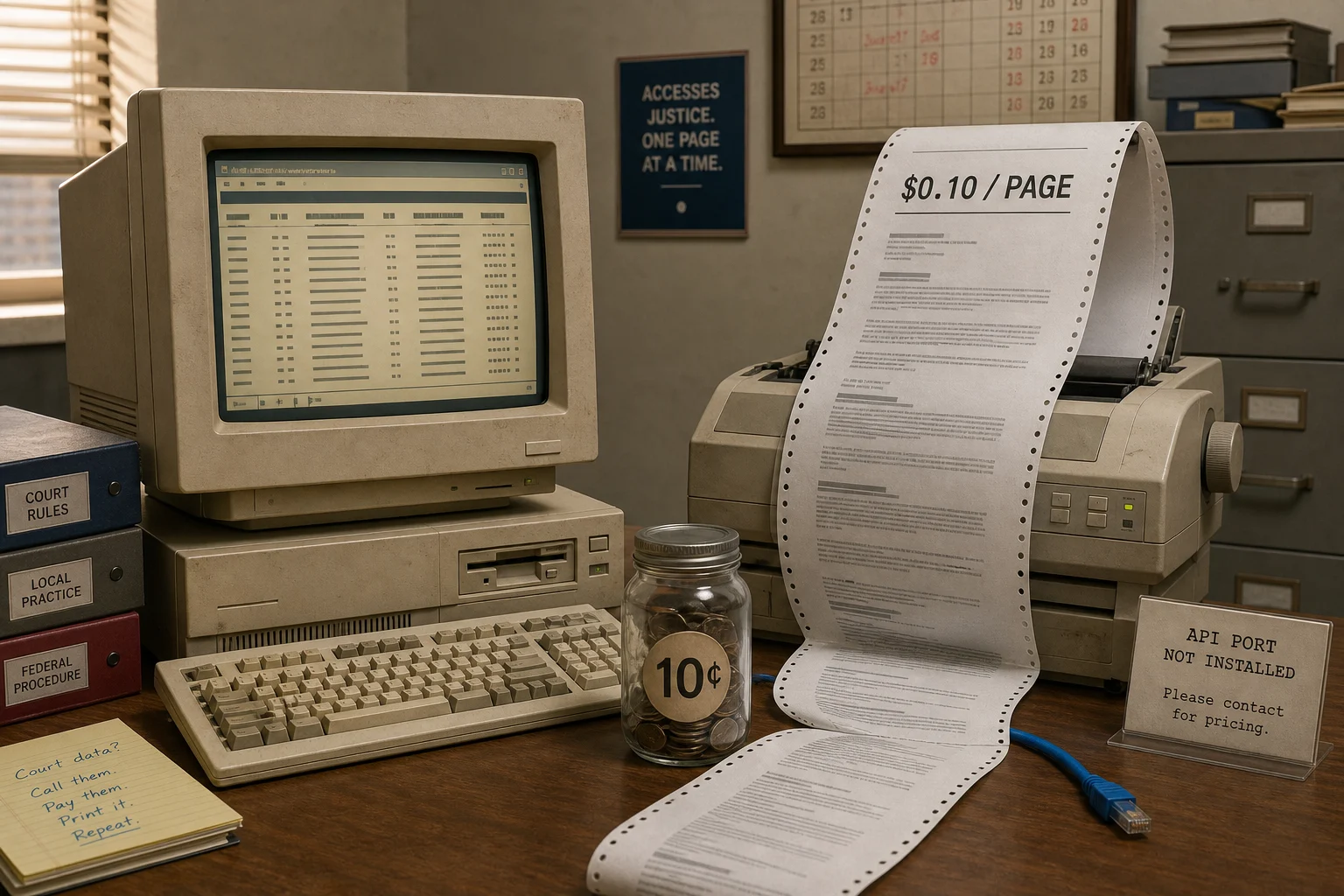
The pricing costs most for anyone who monitors a case rather than looking something up once. PACER has no push notifications and no change feed, so to see whether a docket changed you pull the docket sheet again and pay again, even if nothing moved. Checking a single active case with a 30-page-plus docket sheet daily costs $90 a month, and checking it weekly costs $12.
The fix is coming. Slowly.
The same month, the Judicial Conference announced an accelerated modernization timeline. Judge Michael Y. Scudder said the new system is on track "two to three years sooner than originally expected," with early components being tested at six courts through 2026.
Even on the accelerated schedule, a new PACER is a couple of years away, around 2028 or 2029. As of this writing, the fee schedule is still $0.10 a page with a $3.00 cap and no exemption for journalists or researchers, and no legislation has passed to restructure the paywall.
The people running PACER have told Congress they want it replaced too. Today, though, PACER is a metered, session-based portal built for one-off lookups, and software that relies on it pays per page. If what you need is current, structured, cited court rules that you can check as often as your workflow needs, Court Rules has a compliance-check endpoint with a rate limit of 60 requests a minute.