How to Count a 14-Day Federal Court Deadline
A rule that says "14 days after service" can end on a different day than the one you mark, because weekends, holidays and court closures move the deadline.
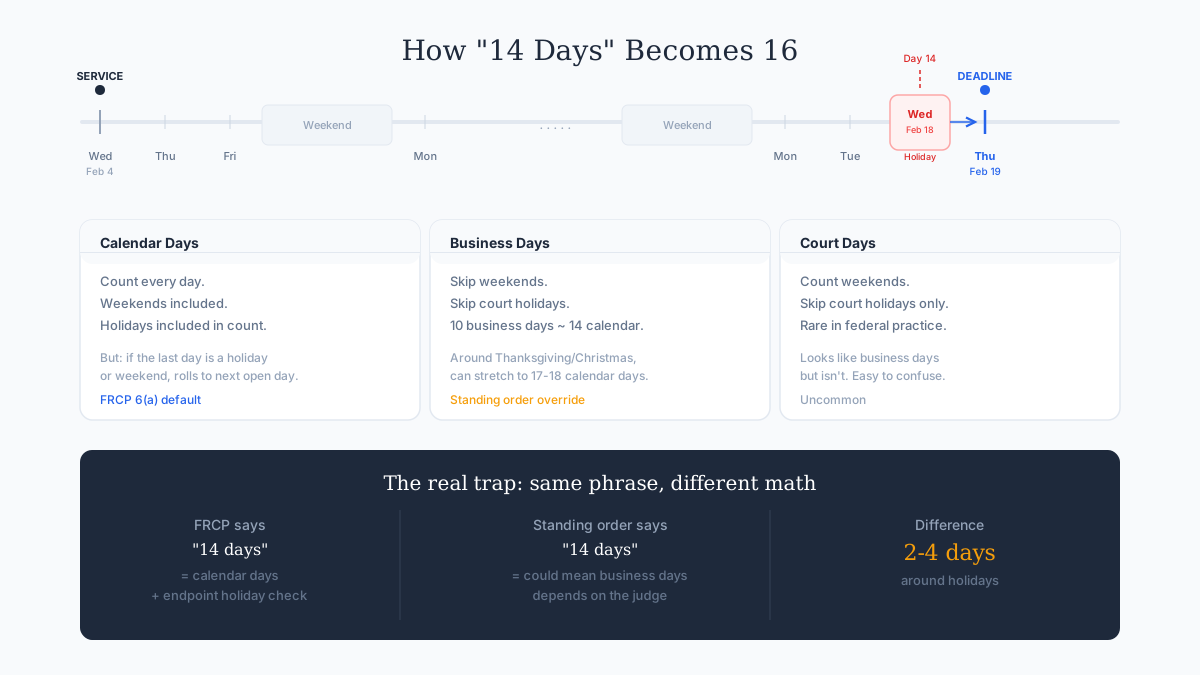
A deadline that moves
Opposing counsel serves a motion on a Wednesday. The rule says you have 14 days to respond. So you count 14 days on your calendar, land on a Wednesday two weeks later, and mark it as your deadline.
If that Wednesday is a legal holiday, the deadline moves. Under FRCP 6(a), when the last day of a period falls on a legal holiday, the deadline moves to the next day that isn't a Saturday, Sunday or holiday, so the deadline is Thursday. If Thursday is also a court closure day, the deadline is Friday.
Most litigators know the weekend rule, and fewer think about holidays. Almost nobody thinks about court closures, which are days that aren't federal holidays but when the clerk's office is closed anyway.
What FRCP 6(a) says
The 2009 amendments to Rule 6(a) simplified federal deadline counting. Before 2009, any period under 11 days excluded weekends and holidays from the count. Periods of 11 days or more included them. So "10 days" and "14 days" used completely different arithmetic, so drafters picked a number to get the counting method they wanted.
The current rule is cleaner, but still has layers:
- Exclude the trigger day. Service happens on Monday, day 1 is Tuesday.
- Count every day, including weekends and holidays. All periods now use calendar days for counting.
- But check the last day. If the deadline lands on a Saturday, Sunday, or legal holiday, it extends to the next available day.
The third step causes the most mistakes. If day 1 is a Tuesday, day 14 is the Monday two weeks later, and if that Monday is MLK Day, the deadline moves to Tuesday. A filing made on the holiday, on the assumption that the clerk's office is open, might not be processed that day.
Three kinds of "days"
Federal rules and standing orders use the word "days" in three different ways.
Calendar days are the simplest, because you count every day, including weekends. Most FRCP deadlines use calendar days for the count itself, so "30 days after service" means 30 calendar days.
Business days skip weekends and holidays. When a standing order says "10 business days," you skip Saturdays, Sundays, and every day the court is closed. Ten business days is usually 14 calendar days, but around Thanksgiving or Christmas it can stretch to 17 or 18.
Court days skip court holidays but not weekends. Federal practice rarely uses them, and they are easy to confuse with business days.
The FRCP counts calendar days but then applies a business-day rule to the endpoint, and a standing order can override either part. A judge who says "opposition due within 10 business days" is replacing the entire FRCP 6(a) framework with a different counting method for that one deadline. You need to know which system you're in before you start counting.
The holiday problem
Federal courts observe the standard federal holidays: New Year's Day, MLK Day, Presidents' Day, Memorial Day, Juneteenth, Independence Day, Labor Day, Columbus Day, Veterans Day, Thanksgiving and Christmas, which makes 11 days.
Individual courts also close for reasons outside the federal calendar, such as weather or local observances. Most courts treat the day after Thanksgiving as a holiday even though it isn't a federal one, and some courts close for state holidays.
FRCP 6(a)(6) defines "legal holiday" to include any day declared a holiday by the state in which the court sits. So a deadline in the Southern District of New York might be affected by New York State holidays that don't affect a deadline in the Central District of California.
And none of this is published in one place. You have to check the court's website for their specific closure schedule, then factor that into your count. For a single deadline, it takes five minutes. Across a litigation practice handling cases in multiple districts, it's hours of invisible work every month.
When standing orders change the math
Even if you nail the FRCP 6(a) calculation, you might still be wrong. Individual judges override default deadlines all the time.
For example, the FRCP gives 14 days for an opposition brief, but standing orders frequently shorten or extend this. One judge in SDNY gives 21 days, and another gives 10 business days, which can differ from 14 calendar days when a holiday falls in the period.
Reply briefs vary even more. The FRCP default is 7 days, but standing orders often change it to 5 business days, 10 calendar days or "one week", and "one week" can be read as 7 days or as 5 business days.
To compute a deadline you need the trigger event, the counting method and the holidays that apply, and missing any one of them gives the wrong date.
A worked example
Opposing counsel serves a motion for summary judgment in EDNY on Friday, November 21, 2025. The standing order says opposition is due "14 days after service." Calendar days, per FRCP 6(a).
Day 1 is Saturday, November 22, because the trigger day is excluded. Day 14 is Friday, December 5, which is a regular business day, so the deadline is December 5.
If the same motion is served on Wednesday, November 19, day 1 is Thursday, November 20, and day 14 is Wednesday, December 3.
If the standing order says "10 business days" instead, you skip weekends, Thanksgiving (November 27) and the day after Thanksgiving if the court observes it. The deadline is then December 4 or December 5, depending on whether that court closes the day after Thanksgiving, so you have to check the court's holiday calendar.
A calculator for these deadlines
The Court Rules Deadline Calculator counts calendar days, business days and court days for every federal district we cover, and it uses each court's own holiday schedule.
You pick a court, a start date and a day count, and the calculator gives you the date and the holidays that fell in the range. You can export the result to Google Calendar or download an .ics file for Outlook.
You can also browse court holiday schedules directly. Each district page shows the full closure calendar for the year, including both federal holidays and court-specific closures.
The calculator is free and needs no login.
Stop counting on your fingers
Pick a court, pick a date, get the real deadline. Holiday schedules for 20 federal districts are already loaded.
Related: Calculating Federal Court Deadlines With the CourtRules API (developer guide) and How Rule 83 Lets Each Federal Judge Set Their Own Procedures.